
On a Facebook group about SDAM, someone had asked “What is your narrative about your life? Is it things like ‘I am a good parent,’ ‘I like to play football’. I got the impression they were really asking How do I describe myself when I don’t have access to my autobiographical memory? How do I know that these things I think are me, actually are a true representation of who I am?
It’s a valid question. A few years ago I was asked Who Am I Without My Wounds? I had no idea and it became a turning point in my life. I had no narrative about myself that I could rely on as being true. People with SDAM have little to no autobiographical memory. People with Aphantasia often have little to no episodic memory. Put the two together and you definitely have a memory that is ‘dodgy’ at best.
My narrative had become a lot of stories about me. But like stories that are told over and over again there is a chance of them turning into versions that are no longer the same as the actual happenings – a bit like Chinese Whispers. I had no idea how much truth these stories still held because the actual memories are lost. They could be totally true or so warped by constant re-telling that truth was lost. Most likely they were somewhere in the middle, but I had no way to know that. The stories I told were also of the traumas of my life. There were very few of happier times.
Did I really travel from one traumatic experience to the next in such a way for over 65 years?
And if I took away the stories, what would be left? Would I even be able to recognise myself?
That was a very freaky thought – that I was nothing but a heap of stories that may no longer even be true in the detail, even if the basis of each story held truth.
So I wrote them down. Published a book, and then, because all those dark stories were keeping me in fear, I allowed them to go, to disappear, knowing that if I ever need to recall them, I can simply pick up my book and read them.
But people got in touch with me. My tale had touched them and I discovered that my stories had helped other people understand their stories better, or had reassured them that they were not alone.
It didn’t happen overnight and a whole lot more understanding of how I function in this world had to be discovered and accepted, before I could fully let my stories go, but writing my stories – my narrative – was the first step to healing.
This morning, as I write this, a post appeared in my Facebook feed. It was a picture of a page from a book. I read the text, thinking that I really could relate to what the author was saying. I loved the syntax, the choice of words used and even the cadence seemed as if it talked to me. It felt like something I could have written.
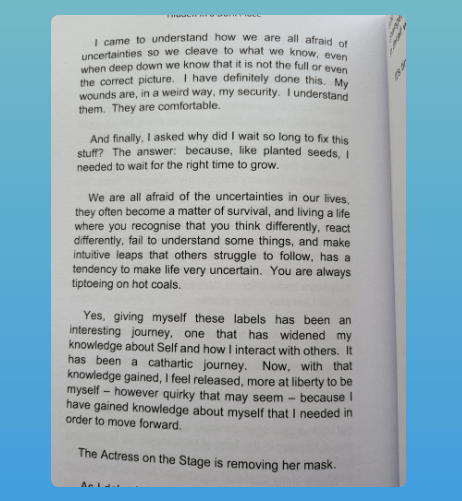
Who wrote this? I wondered. And then I reached the final sentence on the page and realised that I had written these words. This was an excerpt from my book Hidden in a Dark Place.
This was confirmation that I had let my painful past sink into the obscurity of SDAM – and I am not lost as I thought I would be. I gave myself a lifeline by writing that book and accepting the risk of losing my past. I may not know who I am without my wounds, but I know that the wounds were not ALL I was. Now, I am stronger. Now I have learned to believe in me.
Thank you for reading
Please like and subscribe
Check out my new Facebook group: https://www.facebook.com/groups/dragonsandbooks
Auri’An Lay
Life through a neuro-divergent mind
 Stories and More from Auri'An
Leave a comment